Grab a coffee … this felt good to write and think about … it’s a little like some of my older ranty posts and that feels good …
Ready to dive in?
I had an agreeable disagreement this week in the supermarket (I won’t elaborate) and we’re also looking at our gender balance at A level (in my day job) and it got me thinking about the extent to which girls don’t continue to study maths is because of society’s view about maths/STEM subjects.
So much has changed about the gender imbalance in some STEM subjects but we still have some work to so … I did engineering back in the day when I was one of about 15/20 women out of about 250 students at Warwick and was specifically invited to “women in science and engineering” meetings where I was told we’d get a job because we were women … my response was that I didn’t want a job because I was a woman, I wanted to get a job because I was a good engineer and got sneered at. I wasn’t invited to any more meetings!
Saying “I’m not good at maths” is arguably one of the most socially acceptable, self-sabotaging cultural habits and most people who do it, don’t even notice when it happens. If you stood up at a dinner party (not that I do go to dinner parties) or in a staff room or even a pub and said: “I can’t read a single sentence of this book … I’m just completely illiterate,” you would be met with horrified silence and a great deal of sympathy from people making all sorts of assumptions as to why that would be the case. Yet, all the flipping time people proudly and casually laugh off the phrase, “Oh, I can’t do maths to save my life, I’m just not a numbers person”, as if it’s a badge of honour.
This cultural double-standard is a massive fecking problem … “maths bashing” is actively harmful for several reasons.
It acts as an accidental “Permission Slip” for children.
When a parent or a teacher says, “Don’t worry, I was never any good at maths either,” they think they are being comforting and reducing pressure. They think it’s a lifeline, but educational psychology research shows that when children hear this from a primary attachment figure (someone they admire), they may internalise the belief that mathematical ability is a fixed, genetic trait (think eye colour, hair colour) rather than something that grows with effort. It gives the kids a subconscious permission slip to completely opt out and stop trying the very second a mathematical problem requires effortful cognitive struggle.
The gender confidence gap is heavily reinforced.
Maths bashing is deeply gendered, and it is quietly devastating young girls’ confidence. A massive UK GL Assessment survey of over 1,000 teachers (back in 2024) revealed that 50% of teachers believe girls advance more slowly in maths because they work too cautiously to avoid mistakes (compared to just 5% who think the same of boys). Now that’s a whole other blog post brewing there about how making mistakes is a good thing!
Additionally, data from National Numeracy’s recent Number Nation report (published in Jan 2026) shows that mothers are significantly less likely than fathers to feel confident supporting their children with maths homework (69% compared to 83%). When mothers inadvertently pass down messages like “maths isn’t my subject,” research shows that their daughters’ achievement and confidence drop almost immediately. This one got me thinking about my Mam … she had a little corner shop, and I saw her “doing Maths” every single day as she tallied up what people were buying by hand (think Arkwright’s store in Open All Hours and you’re almost imagining my Mams shop).
It can trigger “Maths Anxiety”.
Saying “I’m bad at maths” isn’t just harmless self-deprecation … it can fuel a clinical phenomenon known as maths anxiety which when faced with a numbers problem, individuals with high maths anxiety experience the exact same physiological threat response as someone facing a physical danger … their working memory gets completely flooded with panic, which literally “freezes” their ability to process numerical logic.
As a maths teacher I know that for some students this can be a massive obstacle to learning … by normalising the idea that maths is a terrifying, elite skill meant only for “geniuses,” we are actively inducing performance panic in our students
It comes with a massive economic and personal cost.
On a societal level, this “anti-maths mindset” is an absolute disaster … National Numeracy statistics show that over half of the UK’s working-age population (around 54%) possesses only primary-school level numeracy skills which is terrifying. Allegedly, this lack of basic numerical fluency costs the UK economy a staggering £25 billion annually in lost productivity and errors but more importantly to me is the individual impact … leaves people intensely vulnerable to mismanaging debt, falling victim to financial fraud, and maybe shying away from higher-paying jobs that involve data or budgeting.
Let’s try to change the narrative … maths is not a genetic curse … the difference between high-performing East Asian systems and the West isn’t that their kids are born with better mathematical DNA … it’s that they view mathematics as a standard, universal skill that anyone can master through deliberate, effortful practice and hard work.
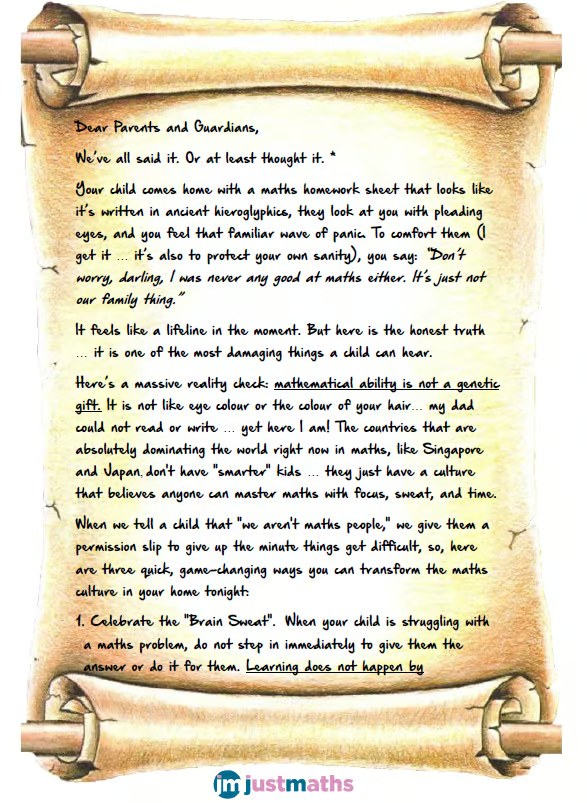
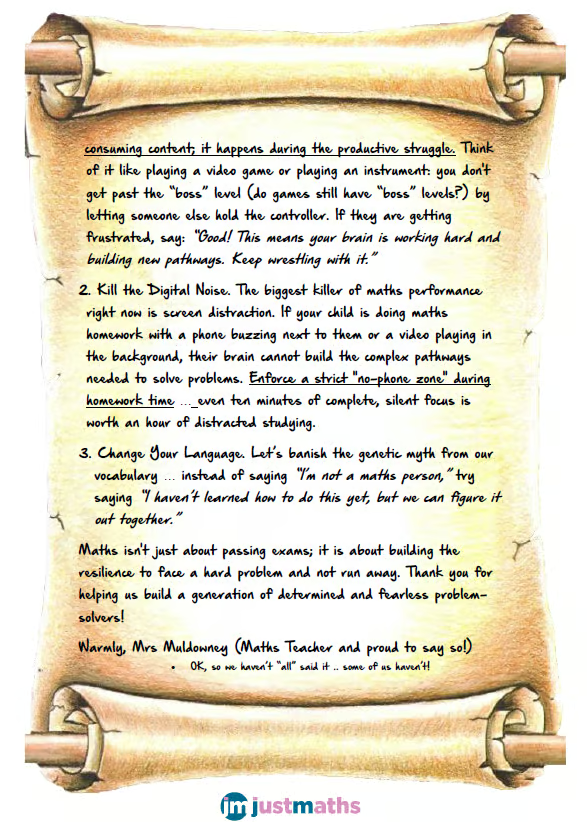
If we want our kids to become resilient, fearless problem-solvers, we have to start treating numeracy with the exact same respect as reading and banish the phrase “I’m just not a maths person” from our homes and classrooms entirely … so I’ve written something in the form of letter to parents that I’d love to send (don’t worry boss I won’t! but I might get them up on open evening and parents evenings!). What I have done though is that I’ve adapted these into posters for my classroom as a letter to my students which will go up in my classroom next week.