 I always joke that I took Engineering at uni because I was told by a careers advisor: “Don’t be silly … women can’t be engineers!” and I am not that old that we are talking about the 1800’s here people, but if I’m honest I had a genuine love of Physics and a curiosity as to “why stuff works”. I’m sure I used to drive my old Physics teacher (Mr Hinton) mental forever asking questions but I can’t remember there ever being other subjects I was attracted to. I also don’t remember the teachers of other subjects falling over each other trying to get me to do their subject, for example one of my A’s was in Textiles (there were no A*’s in my day) and was never approached to carry it on. I’m not sure what that said about me as a student!
Anyway, enough reminiscing … It’s the time of year when students are making decisions about their A levels – so the below is a guest post from Dr. Will Whittow at Loughborough University that may be useful to encourage students to choose Maths as a subject and also includes some information about their approach to Electrical Engineering as a university.
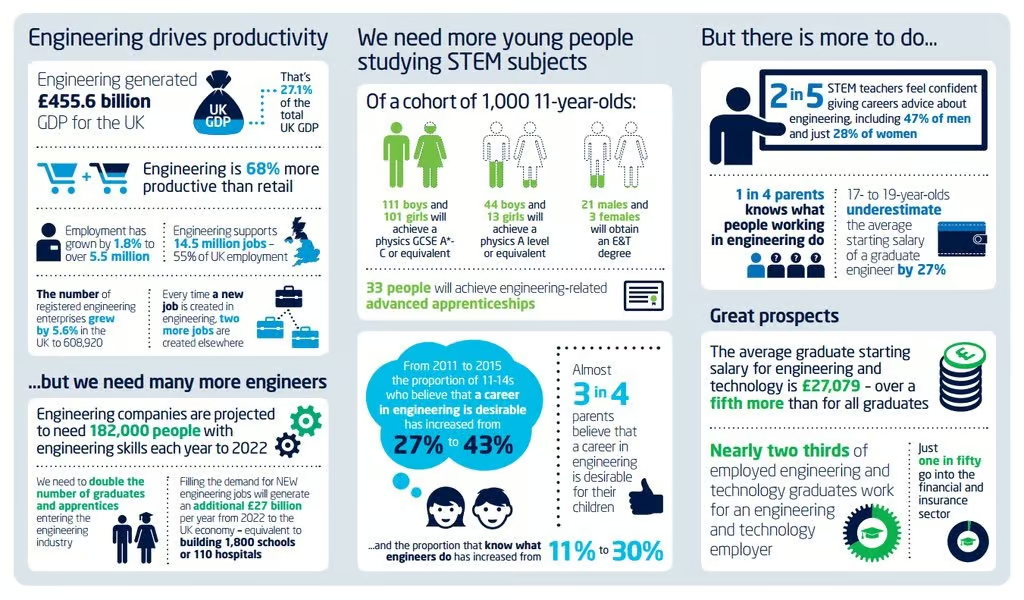
Here’s a Maths question for you: If Engineering contributes 25% to UK’s Gross Domestic Product (GDP) but only one in six 16 year olds really knows what Engineering is, what is the probability of an incredible career? You can work out the probability yourself but as a quick estimate, the answer is FANTASTIC if you want to grab the opportunity. Choose Maths A-Level to keep your options open for millions of exciting and rewarding Engineering careers.
 Close your eyes for a second and imagine the world in 2030, 2040 or even 2050 – has it stayed the same? Or do you see driverless electric cars; renewable energy powering our lives; intelligent transport; connected sensors forming the Internet of Things; and healthcare systems monitoring and supporting people in their own homes? Do you expect to be using the same smart phone in 2030? What will your phone be capable of in 2050? The possibilities are endless.
 The only thing we know for sure is that our world and way of lives will be unrecognisable within 20 – 30 years. Engineers are pioneering this change. If you are reading this, you are excellent at Maths and you can actively contribute to this technological revolution.
Engineering is not just engines or yellow hard hats. Engineering is not just for boys. It is not just fixing things. Engineering is observing, imagining and inventing the Future. Maths is at the heart of Engineering. Engineering is at the heart of EVERYTHING.
Many of you will be learning or thinking about learning to drive. It is a pivotal moment for many 17 year olds. However, I believe, kids who are born in 2016 won’t learn to drive. Why would they when all cars will be autonomous and the cost of insurance for human drivers will be huge? So how much maths is needed for autonomous vehicles? GPS systems use the time difference from electromagnetic waves to triangulate their position in space; radar is constantly sending and analysing received signals to detect nearby objects and intelligently react accordingly. Your brain does incredible things when you drive but the human brain can get distracted, sleepy and make mistakes. To replace the human driving we need brilliant Engineers using intricate maths to make the world better.
Perhaps you want to be a superhero and save the planet. Your generation will have to battle Climate Change. One solution will be renewable energy. Your creativity, mathematical ability and determination could help to pave the way to this solution.
When the New Horizons probe passed Pluto, it was doing experiments and sending data from 500 billion km away. If that doesn’t blow your mind, think of every time you have got up and walked 10 yards to find a WIFI signal. Living without WIFI seems unimaginable now, yet only become common 12 years ago. Maths makes these things happen. Engineers make the impossible possible. They take on the challenge of making yesterday’s science fiction into the knowledge and technology that we take for granted today.
By 2040, there may be 100 trillion sensors on the planet. That’s a BIG number: 100,000,000,000,000. By 2040 there may be 10 billion people on the planet. How many sensors is that for every human being? You may need to check your maths as the number is hard to believe.
Engineer is a broad phrase that includes Technicians and Mathematical Geniuses. Normally, to study Engineering at University, you need Maths and Physics A-Levels. At Electrical Engineering at Loughborough we have a more flexible approach as we want to attract the very best candidates, from across the genders (80% of Physics A-Level students are male) and from all backgrounds. We ask candidates to have A-Levels in Maths and at least one science subject of any discipline. We also offer a Foundation Year for students who do not have a Maths A-Level. To help you with your A-Level Maths Revision, I highly recommend the free Mathscard app (www.mathscard.co.uk)
Engineering in numbers:
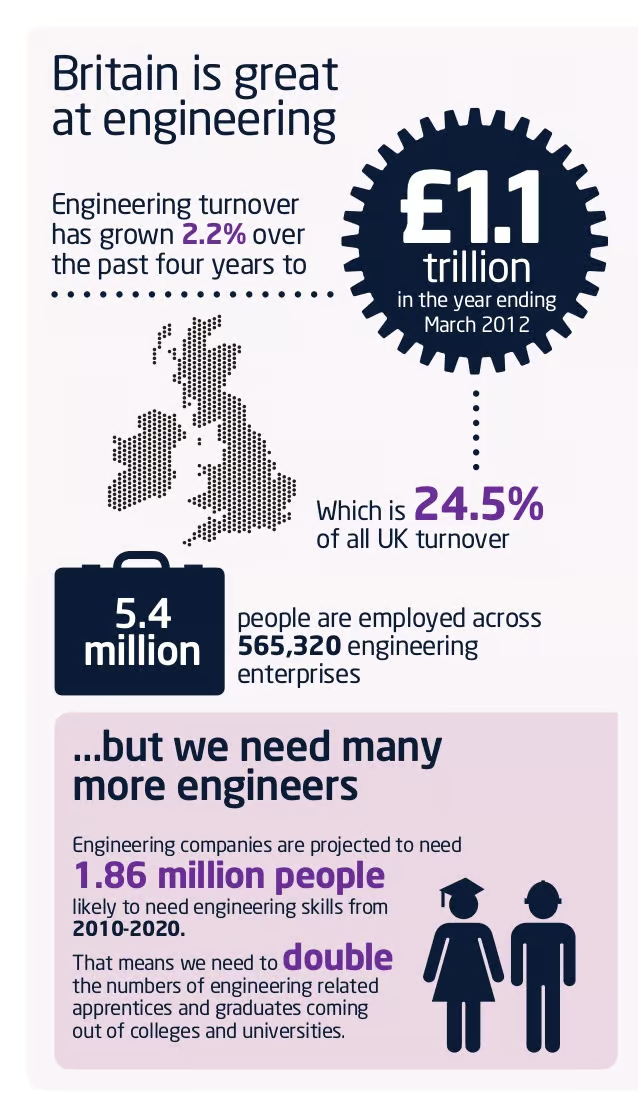
- Generates ~£1 Trillion to the UK economy and employs 5.4 million people in the UK;
- UK needs twice as many Engineering graduates to meet demand (182,000 per year);
- Loughborough Electrical Engineering Graduates start their careers with average salaries of £29k;
- Chartered Engineers earn £69k on average.
Do the Maths and Engineer your Career!
Dr. Will Whittow, Senior Lecturer and Admissions Tutor, Wolfson School of Mechanical, Electrical and Manufacturing Engineering at Loughborough University
@willwhittow
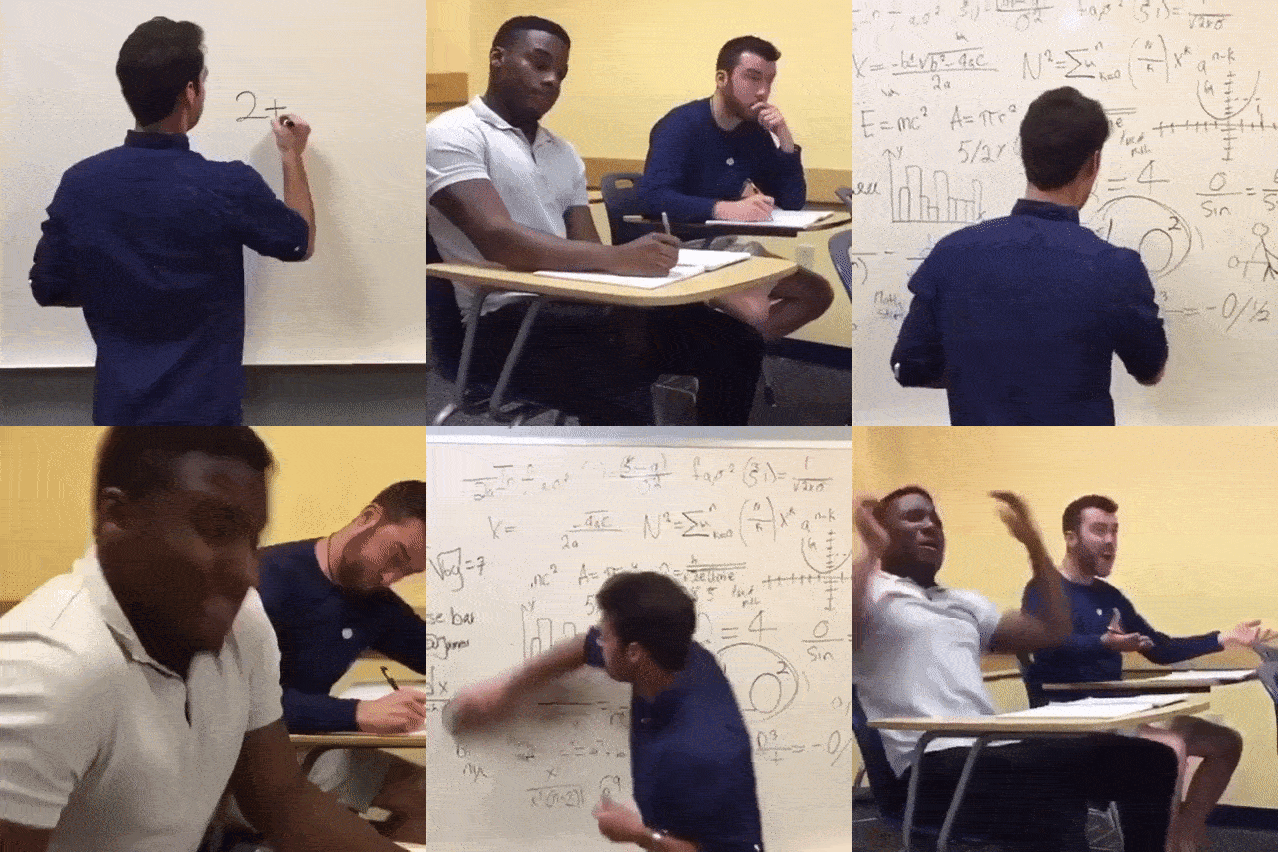
MEL: My thanks to Will for the above. I know I’m thinking about getting some of the above images made up as posters for my room. I must also thank him for the below gif which reminds me of certain students!

Haven’t finished reading this yet but glad to see that you too excelled in textiles, followed a career or two then have changed and am enjoying teaching maths! No one encouraged me to do anything with my skills in textiles ( late 70’s) – especially not my parents – who knows what might have happened if I had? 😯
I was told by an engineering course at one particular university that girls shouldn’t do engineering and that was in the 90’s!
Things are changing and this is a great article to show how important our profession is to the UK and the World. I love being an engineer. There are so many challenges that we are going to be facing in the coming decades and I want to help find those solutions.
I remember a lecturer, in the early 2000s, addressing our lecture hall full of maths UGs saying, “girls can’t do maths!” Certain opinions seem to die slowly.
I am a professionally trained careers advisers, trained in the early 1990s, and I can’t imagine any careers advisers saying that girls can’t be engineers. Gender stereotyping and how to challenge it was a big part of our course, and most people enter career development work because they are interested in social justice and opening up opportunities to people. Our code of ethics also focuses on equality and diversity. I find it hard to believe that a professional careers adviser ( as opposed to the woodwork teacher who also had some responsibility for careers would have made this comment). I hope your blog does not not put people off seeking the careers advice that could help them explore their full range of opportunitities. Otherwise, it’s an interesting post and thank-you for sharing.
I am sure it wont act as a deterrent … things have changed … this was 30 years ago and I can assure you that it was said to me!