Last week I put a shout out to see if anyone wanted to write a guest post and lo and behold Rob Smith ( @mrrismithmaths ) stepped up to the plate … this isn’t the Rob Smith ( @RJS2212 ) lots of you know on twitter for spamming your timeline recently with requests for one word to describe maths (as part of Billy Adamsons @Billyads_47 ) quest to produce a wordle!). This is a totally different Rob Smith. Seriously how many Rob Smiths can the world take …. However this one seems much more sensible (to the “other” Rob Smith – I love ya really!). It all feels a little “will the real Slim Shady please stand up!” but anyway, back to the point.
So Rob Smith offered to write a post on his views on “Writing a ‘Mastery’ Scheme of Work for the New Maths Curriculum.” Looking at the way other departments work and into the minds of heads of department is something all teachers are really interested in and I too have some views about “mastery” – HERE IT IS so dear reader I offer you Rob Smith … soon to be Head of Maths at Northampton Academy.
Having recently become a first time father to the handsome baby Isaac, I didn’t think that my tired body and mind would allow myself the time and focus to write a new Mastery Curriculum, but here it is! Ever since leaving my post as Key Stage 3 Coordinator at a successful school in Milton Keynes in 2012 to take up my first Head of Department position at a Free School (don’t hate me please!!!) in Bedford, I have been trying to construct the perfect ‘Mastery’ Curriculum. It has to be said that my first attempt, whilst at the Free School, was only a partial success. I wonder how many Maths Colleagues from around the country have been in the same position as I was, it is a BIG job!! In September 2014 I took up the role of Key Stage 4 Coordinator at Northampton Academy, and I look forward to becoming Head of Maths at the Academy next year. I am now at the stage where I think that I am on my way to having designed a SoW that meets all of the needs of our students – I would love to get some constructive criticisms on how I can improve it!
Stage 1: Research
Throughout this journey I have been constantly combing the web for useful nuggets of information and opinions as to how others have gone about the task of writing a SoW for the new curriculum. There were so many questions to ask at the start of the process:
- Why don’t we just use a SoW that comes directly from the exam board? I’m not convinced that the ‘one-size-fits-all’ approach works. I had to find something that works for our students. I also wanted a 5 year journey, not separate SOW for KS3 and KS4 as I’d been using in my career so far. (MEL: hear, hear … students are on a 5 year journey!)
- What is ‘Mastery’ anyway and does it work? Surely it’s boring for the students (and teachers?!) to spend so long on topics? Here there is only one direction to point you in – the Mastery Master himself @mrreddymaths blog here. Having spent some time with Bruno, I can see why he has been so successful – he is very clear in his vision of what a curriculum should look like, I hope that I can put my vision across as clearly!
- Who else has tried a ‘Mastery’ curriculum? I strongly recommend reading @mrbartonmaths blog on writing a new scheme of work here. It’s epic, but certainly worth the time and effort to read! Also @workedgechaos here, the NCETM here and Kangaroo Maths here.
- Should we buy into a scheme like Mathematics Mastery (@mathsmastery): This was the toughest decision for me – Why reinvent the wheel right?? Clearly Mathematics Mastery is an excellent ready-made teaching framework, that also comes with classroom resources, et al. I think that it is the Control Freak inside of me that decided not to sign up for this – I don’t know if I could have handled having so much prescribed to me. (However definitely worth noting that I have spoken to colleagues that have signed up to the programme and they couldn’t speak more highly of it!!)
Stage 2: Deciding on the philosophy of my curriculum.
Having spent the best part of 3 years considering what I want my curriculum to look like, you’d think that I should by now have a clear vision of what it was going to look like! Here are the key principles that I am sticking to:
- Depth of understanding over breadth of knowledge: Spend more time on fewer things. As a department we agree that all teachers will move their class on to the ‘next’ topic at the same time. Instead they will give their class experience of Rich Tasks (we’ll get onto that later!), more practise and further applications. We need to strike the correct balance between practise of key skills, and discovery and inquiry. I am particularly interested in embedding some of the ‘Inquiry Maths’ tasks from Andrew Blair @inquirymaths.
- Each half term has a different focus, with Year 7-10 working at different levels on that focus: I believe that this will encourage greater depth of planning and more collaboration from the teachers and will hopefully encourage pupils to chat to each other about the content too. I plan to have the scheme of work on an interactive Excel Spreadsheet so that appropriate activities are hyperlinked to each topic to ease the burden on planning.
- Essential Rich Tasks: Every half term will have a ‘low-entry, high-ceiling’ rich task that all students will complete. Teachers will do this task first in department time so that they can come up with a series of probing questions and extension tasks, and also so that they are in a better position to be able to guide the students. The planning of these tasks should go into questions and prompts rather than powerpoints and worksheets. These tasks will be marked using a WWW, EBI policy – it is fine for them to be peer assessed and not scored, as such. There will also be a bank of ‘Other Rich Tasks’ for use when a teacher feels that they have exhausted all of their own resources on a particular topic. Top sets will also complete ‘training’ for the Maths Challenge. I hope to collate these Rich Tasks in the near future, I have sourced them from places such as nrich, but they do need editing to make them more classroom friendly! Kangaroo maths, Mr Barton Maths , Solvemymaths, resourceaholic and Don Steward’s Median blog. have a good collection of links.
- Homework: 1 essential homework per fortnight. This is an idea that I got from Craig Barton’s blog that all students will complete 1 centrally produced homework each fortnight, comprising of 20 marks from the current topic and 10 marks from content that students have been taught previously. The results of these assessments will be kept centrally and will hopefully promote a greater importance of homework amongst the students. Teachers will also supplement this by setting their own homework too. These homeworks, along with all assessments will be kept in an assessment portfolio which will be with the students every lesson – they can add to this portfolio with exemplar work in any lesson.
- Assessment: Once per half term. Regular assessments will take place each half term, with a ‘baseline’ test at the start of year 7 and a larger, more holistic test sat at the end of each year. Year 10 and 11 will sit a whole exam paper each half term, in order to familiarise themselves with exam content and question style.
- Importance of numeracy: All year 7’s, 8’s and 9’s will have additional ‘Numeracy’ lessons – 1 per week, during which time they will work on written methods and all of the numeracy that supports the learning of the current topic. This time will also be used to work on ‘Maths Challenge’ style questions.
Stage 3: What’s going to be taught when?
Probably the most important part of the planning process for me was deciding on how to lay out content to allow for sufficient structure. I envisaged a scheme of learning that took the best parts of the Mastery Curriculum that I’d seen from Bruno Reddy at King Solomon Academy, and merged them with the traditional, cyclical approach.
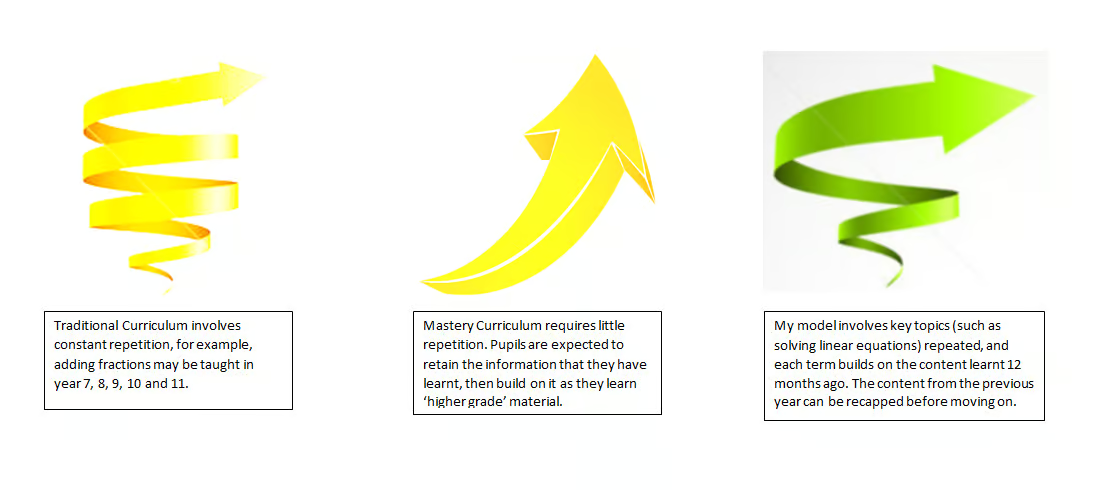
When I sat down to decide the order in which things would be taught under my model, I knew that I wanted to start with number, however I was aware that I do not want to put pupils off maths by not starting with the ‘new’ stuff! I believe that this can be overcame by the use of Rich Tasks which enable students to practise the basic skills that are needed, whilst developing the inquiring minds that we aim to foster. For example What’s Possible? From nrich, this from nrich is a useful tool for mapping the content. As I have said before, I firmly believe that the planning for these tasks has to be collaborative and has to focus on creating prompt questions for the students, we should aim to get the team talking about the maths and collaborating. As pupils do more of this type of task, hopefully thy will gain more confidence and will be more able to come up with their own inquiry questions.
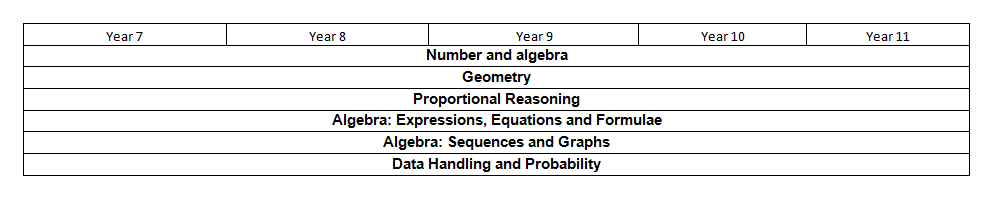
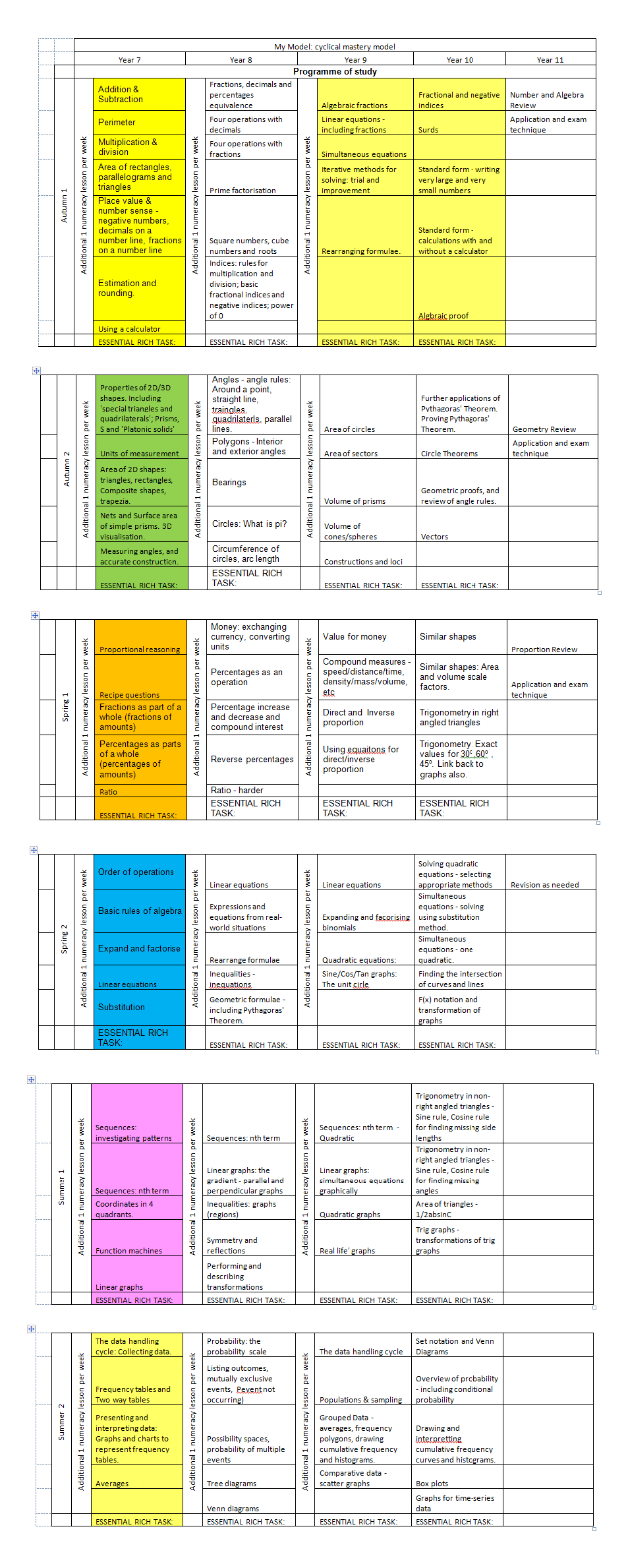
I want each year group to be working on the same element of mathematics at the same time, to enable the best possible opportunities for collaboration and high quality lesson planning. The table below shows a brief outline of what will be studied at each time of the year.
Whilst I recognise Bruno Reddy’s comment that minimally different topics should be separated, I believe that sometimes there is a need to give pupils a deep understanding of the bigger picture. I hope that I’ve got the balance right here, separating minimally different topics where I have deemed it appropriate – I have kept ‘averages’ together, whilst separating ‘area of circles’ and ‘circumference of circles’.
Remember: It is important to keep students well practised in ‘the basics’ – I will achieve this through cumulative starters and through the supplementary numeracy lessons. Students cannot solve problems (or indeed access the problems) if the basic foundations of mathematics are in place.
I’d love some feedback on the Curriculum that I have put together – it is still very much in the development phase (I certainly need to add in success criteria for each ‘topic’), but I hope to roll it out in September.

Hi Rob, I like your ideas on the mastery approach, thanks for sharing. I wondered though how many hours per week do your classes get in each year group to get through the model described by the end of year 10 and how does the programme of work described above suit the sub level 4 students on entry to Y7, what is your approach to get them through the above model so they can see mastery skills being developed at the pace suggested by your model? Thanks for your ideas on this as my faculty too is working on a mastery curriculum and we are always keen to consider what could improve the understanding of the skills needed that students can leave school with and apply in their future lives.
Hi David. Thanks for your comment. We have 6 x 50 min lessons per week,so yr 7-9 will have 2 double maths lessons 100 mins and 1 single maths, 1 single numeracy. I think the the sub level 4 pupils will require more intervention and I certainly feel that we need a different provision for the very bottom 5%. I hope that if we get year 7 right then all but the very weakest students will be able to access a lot of the materials. I know that there is a big discussion to be had about setting structure to enable the highest aspirations in all.
I’d love to hear how you have approached this.
Wow, love your approach & the structure of topics!
Thanks for sharing!
Hi Rob, currently looking to ‘sell’ mastery to the dept and for us to have a complete ethos change here which I assume will be warmly received. As a result I really enjoyed reading your blog and putting your thoughts and ideas out there for people to see and to take and manipulate for their own schools. The one aspect I see us struggling with is time, we have 6 x 1 hour lesson per fortnight in KS3, so 360 mins compared to your 600 over a two week period. You’re certainly fortunate to have so much time with the students.
Anyway thanks once more for giving more ‘food’ to my continual thinking
Thanks for this insight Rob! I am currently in the position of editing a curriculum/SOWs which we initially implemented in Sept 2014 but have come to realise needs some changes making. My ethos for this is exactly the same as yours, blending the mastery approach with aspects of the traditional cyclic methods. The problem I have run in to is how to differentiate between higher and foundation for GCSE. I just wondered what your thoughts were and how you are dealing with it, are you creating different SOW and topic orders? Thanks.
Hi Joe. We’re currently in a bit of transition period – our current year 10 (who haven’t been through the mastery curriculum) have a very much split F/H scheme. When current year 7 get to yr 10 I imagine they will be working on a stretch curriculum if they are high ability, the majority will work on a ‘higher’ curriculum with only a small handful working on a foundation curriculum – those with specific mathematical educational needs only. I hope that this helps!
PS I’ve updated this sow and am happy to send it out to anyone who is interested. 🙂
Hi Rob. How is your mastery scheme going? I’m currently doing a very similar scheme (I don’t mind sending it to you) and it’s based on King Solomons mastery scheme. How do you accommodate the weaker pupils in your lessons with the more able pupils? I’m finding it very difficult to get the weaker pupils at the mastery stage. Any suggestions? Thanks Louise