One of the new topics in both tiers (for all boards) is “use inequality notation to specify simple error intervals due to truncation or rounding”. I don’t get how using the notation is that useful, but the programme of study (POS) does include “use and interpret limits of accuracy” and then note the bit about “including upper and lower bounds” (UB and LB) which means that these remain at higher tier only. The following is not, in any way, shape or form meant to be the full extent of this topic …

As a topic, “error intervals with inequality notation” isn’t something I’ve specifically taught … I didn’t really get my head around it until recently so I’ll explain in more detail before giving you some of my random thoughts.
The basics:
Upper bound – the largest value that a number can be (to a specified degree of accuracy)
Lower bound – the smallest value that a number can be (to a specified degree of accuracy)
Error interval – the range of values (between the upper and lower bounds) in which the precise value could be.
The maths bit:
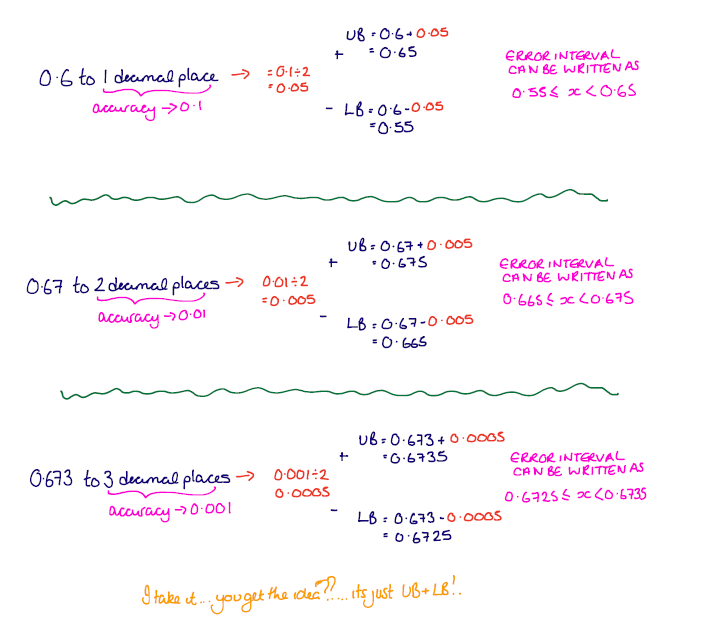
Let me explain with some examples (below) . Remember for any number correct to a specified degree (unit) of accuracy, the exact value lies in a range from half a unit above to half a unit below the given number.
Some of the SAM’s give an insight into how different boards are examining this element of the programme of study – some are including questions explicitly asking for error intervals, and others are wrapping it up into context style questions and those requiring an explanation about how any assumptions they’ve made in their working affect the final answer. OCR gives the best examples of how it’s being examined as a “standalone” topic:

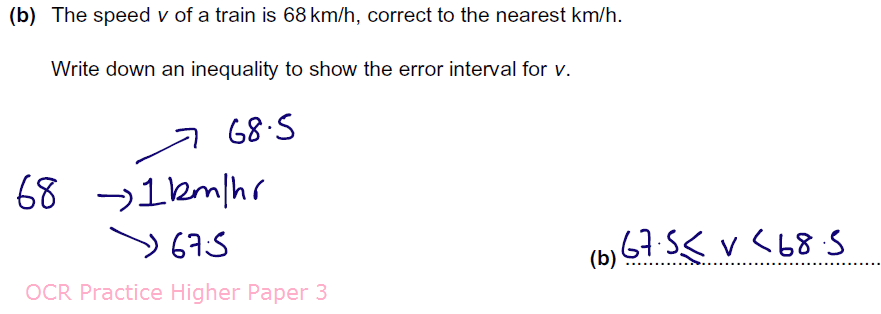
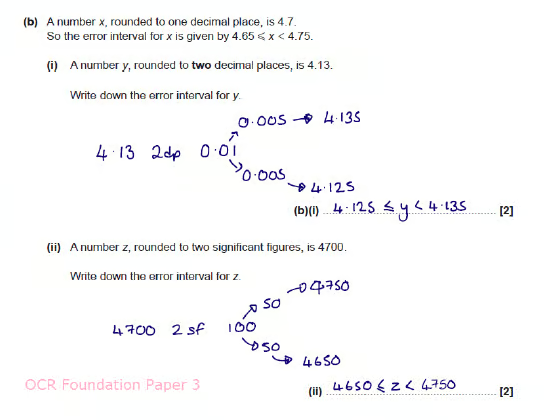
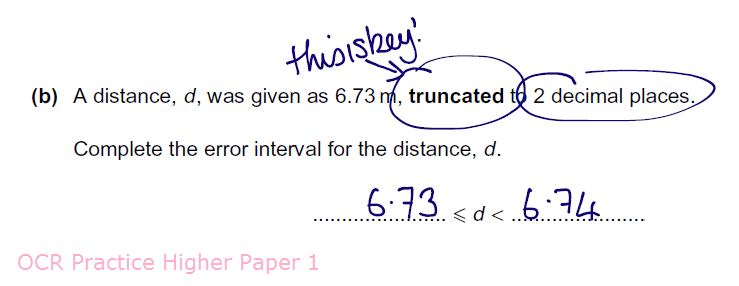
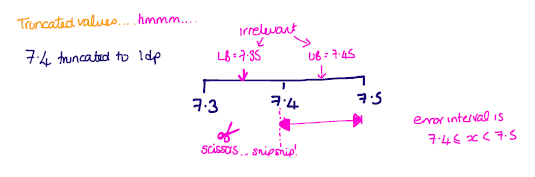
What was interesting is that OCR was the only board that explicitly included a question about “truncation” … it caught me out! This is slightly different in that the UB and LB are NOT +/- half a unit
However, I much prefer the style of question where limits of accuracy are given for say books on a shelf or kitchen cupboards and students have to justify their answers. I know this kind of thing is much more difficult to teach and for borderline students a formulaic approach doesn’t work as the context changes with each question, but from a “teaching for understanding” point of view these kind of questions tick all the boxes for me.
The fact that the “process” in deriving these error intervals is so wrapped up with upper and lower bounds, yet interpreting limits of accuracy including UB and LB are topics limited to the higher tier suggests that whoever is responsible for the programme of study hasn’t got a “Scooby-doo” or just didn’t think it through. It appears to be just another example of how the fact that maths is so interrelated has been ignored and feels like it goes against the principle of not teaching topics in isolated silos or maybe it’s a matter of how the POS is interpreted … I’m trying to play devil’s advocate for a change.
I for one will be introducing the terminology of UB/LB’s … I’m not sure how else we could justify “why” we are using certain values (in any subsequent calculations) without using the terms UB/LB but when it comes to “truncated” values I don’t think I’ll refer to the values as UB or LB’s as that’ll just cause confusion.
As a topic it could be reinforced when teaching most topics that ask for answers to a given degree of accuracy so something that I think should be introduced quite early on in high school maths.
Hopefully the above is of some use in relation to the new topics introduced in the new Big Fat GCSE … You may find this post about the product rule useful too.

I’m reading all your posts about the new GCSE as I tutor children going into Y10 next year so they will be sitting the first exams in 2017. In the first example you wrote the upper limit as 0.55 instead of 0.65 in the inequality. I think I could still give you full marks as a te and isw. 🙂
Hi Cath … thanks for noticing … have updated 🙂
Shows how easy it is to make transcription errors. x
Thanks Mel, clear as…!
Enjoy the summer!
:o)
Could you point me in direction of further explanation of final question on truncated value. i understand the upper and lower bounds but you lost me on the last part about these being iirelevant in the final example.
I think this will help:
Truncation is when all the digits past a given point are cut off without rounding. So for example 2/3 truncated to 2dp is 0.66 whilst rounded to 2dp would be 0.67
Looking at the example I’ve used above 7.4 truncated to 1dp could have been 7.401…. 7.432789…. 7.4999999… etc … all we’ve done is “cut it off” after the 4. Looking at those numbers the error interval could be between 7.4 and 7.5
Working that through like that is probably the way I’d explain it to students too …
Hope that makes sense??
You wrote ‘truncated to 2dp would be 0.67’, instead of rounded. I’m still in marking mode!! Sorry can’t help myself!
I changed that … Well I thought I did! I have now hopefully. 🙂
Thank you for these examples, i’m trying to teach myself about truncation before my lessons this week – your examples are very appreciated 🙂
I joined year 9 in September and next week will be having a test on the entire topic and I have been taught this by my teacher but struggled to acknowledge it but this has helped me a lot thank you!!
this is rubbish teaching
I’m not sure what your point is. Leaving a comment on an anonymous basis also doesn’t help with proving a point! If you have something meaningful to add please contact me direct.
This is so helpful – thank you for all your work, Mel, you’re a lifesaver!
Thank god for the truncated explanation!!!!!!!
Mel
I’m not sure what your thoughts are now on this but here is my understanding and interpretation. I think it’s distinct from upper andd lower bounds:
https://www.youtube.com/watch?v=p5dxqEmAxYw&feature=youtu.be
What do you think?
Kind regards
Steve
thank u so much it helped me a lot with my maths homework. love it !!!!!!!!!!!!!!!!!!!!!!!!!!!!!!1
thank u thank u thank u thank u thank u thank u thank u!!!!!!!!!!!!!!!!!!!!!!1111111
thanks
thank u so much this helped me a lot with my maths homework your the best!!!!!!!!!!!!!!!!!!!!!!!!!!!!!!!!!!!!!!!!!!!!!!!!
xoxoxoxoxoxo
In the question where z is 4700, in the answer you wrote 4670 as the upper bound instead of 4750. (OCR higher practice paper 3, ii)
Hi, Thanks – have updated now.
Hi Mel
As a pedagogical point I’ve always taught it using inequality notation anyway, but I found a good place to introduce it is when gathering continuous data about heights when I first teach class intervals. With a good y7/y8 class you can usually take their heights to 2dp then 1dp then nearest whole, and he idea pops out naturally. Truncation isnicely explained by some pupils of mine as being “like your age” or those division questions fitting 776 pupils onto how many 38 seater buses.
Hope this gives people some nice analogies as ways in to the ideas.
Nice explanation. Thanks for sharing x
On the truncating issue, if something has been cut off the end of the number, then surely the number cannot be equal to the lower value, and must just be greater than it. Any thoughts ?
Comment…
thanks for the great job, I’d just like to ask, if you have a number like 0.5 and you’re supposed to indicate the error range, is it +/-0.1 or +/-0.05
Depends on what the level of accuracy it has been rounded to … if 0.5 has been rounded to 1 dp then it would be +/- 0.05 (i.e. 0.1/2)
Lovely thank u sooooo much it really helped!
Thanks, this was really helpful… i am struggling on one question on some extra revision.
A number, x, rounded to 1 sig fig is 600.
Write down the error interval for x
i thought the answer was 595≤x<605
1 sig fig is the point here .. it answers are 550 ….. 650
add to last comment
…but its wrong
is percentage error included in this topic? I have not seen it on the actual spec but it only on Churchill papers?
I assume you can write percentage errors in the same way if you are rounding percentages to a specific degree of accuracy
M
this is the best very helpfull
Reply to Gary who questioned whether the LB of a number truncated to 1dp (say) can be equal to that very number. Regard “truncated to 1dp” as truncating to 1dp any numbers which have more than one digit after the dp (but to leave numbers with one digit after the dp as it is). Now there is no problem stating the LB is the very number itself..
this is great it really helped with my homework I was completely clueless and now Im able to understand what to do now. thanks 🙂 🙂 🙂 again thx.
Really good… appreciated it. I struggled with it for quite a few days now and when I read through the information it was really simple and helped me to easily understand😁
I very much like dis website as it has all de
answers haha
Thank you so much for your explanations. I’m tutoring a new batch this year and it’s good to know the new things coming in.